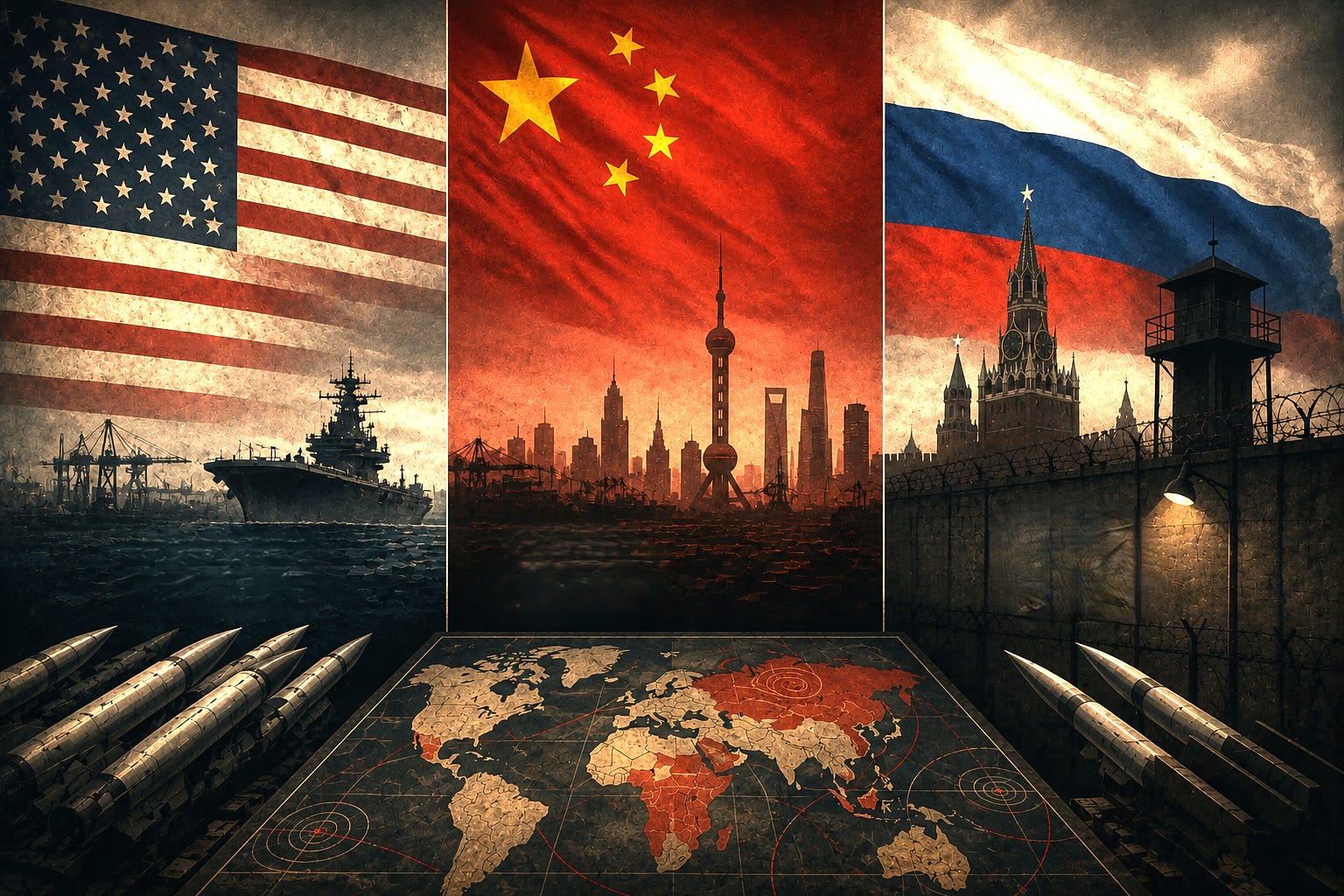
The expectation that if the unipolar model were replaced, international harmony and a “just” order would prevail in its wake is deeply flawed and cannot serve as an argument in the analysis of international relations. Regardless of whether we are dealing with one, two, or multiple dominant powers, international relations retain their principles as a whole. Drawing a parallel with history, a multipolar model would mean an extremely tense and volatile system in which four or more equal actors would dominate certain regions, view each other with suspicion, and constantly test each other’s intentions and readiness to defend their interests.
Medium and small states would fall, voluntarily or not, under the influence of one of these powers, and thus their relations with the others would be incomplete. The competition between the great powers would be clearly visible in all aspects of international relations, including within international organizations, and the risk of confrontation would be increased. A multipolar order does not mean understanding and harmony, but confusion and disagreement—an order in which several Great Powers would constantly seek ways to gain superiority over the others and expand their sphere of influence. This might still lead to containment among a few of them, but “containment” does not at all mean an absence of confrontation. The clearly visible power hierarchy in the unipolar model is the primary factor that makes it more stable compared to the multipolar alternative, which has not yet arrived, if it happens at all.
The opinion that America and the West are in decline along with the unipolar order is highly reminiscent of Fukuyama’s claim about the “end of history,” but with a reversed sign. Both claims are equally wrong precisely because history does not end, and the US and the countries under its leadership have not ceased to exist. The economic crisis of 2008, the two wars of the past decade, and especially the “rise of the others” are cited as evidence for the end of American exceptionalism. The significance of each of these three reasons actually seems exaggerated, because the economic crisis is not the first such situation facing the US, the two wars have not made its military weaker, and placing “the others,” who have actually benefited from the American order, into a unified and coherent category hides risks for accurate analytical results.
It is difficult to argue that the rise of India and Brazil is a factor deteriorating American leadership when both countries are close economic partners of the US, and India is even strategically engaged with America. Both countries are more part of the liberal international order, unlike China and Russia, which traditionally oppose it but do not fail to take advantage of its positive aspects. China demonstrates reluctance and a lack of readiness to challenge Washington’s geopolitical dominance in East Asia, let alone on a global scale. What is happening in Russia could hardly be called a rise, and Moscow demonstrates arrogance based on a dangerous overestimation of its real capabilities.
America and the West as a whole have not finished generating ideas, concepts, and worldviews shared by societies around the world; on the contrary, their principles of democracy, individual liberties, and the rule of law remain extremely resilient and, with the spread of knowledge, become a threat to non-democratic regimes around the world, which include some of the most prominent contenders for global leadership. Therefore, the role of the US and the West is not at all erased, and the assertion that we are already living in a “post-American” or “post-Western” world seems untenable.
Countries like Japan and South Korea, which are not part of the West, have actually adopted many of its traditions and support the current international order. Significant obstacles to US foreign policy are often pointed out, but it is overlooked that most of them are actually obstacles for other states as well. The conviction that the Chinese rise will continue seamlessly at the same pace for decades to come is unrealistic, just like the expectation that every country on the rise will continuously increase its capacity to project power abroad. In this regard, it is more likely that we will soon see the end of the Chinese rise than the withering away of the leading role of the US and the West in shaping the world in which we live.